How to trade memecoins with a small portfolio without letting fees eat the whole position
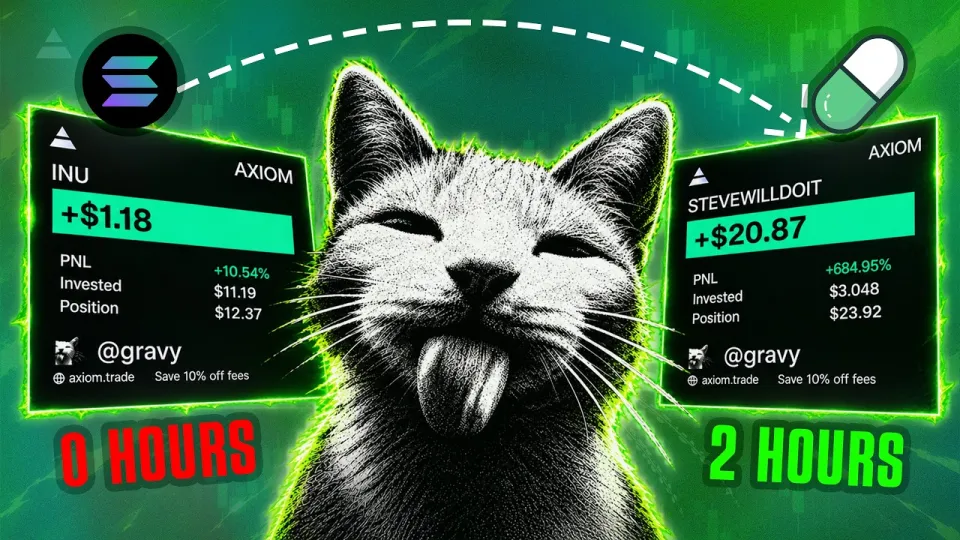
Video: I Tried Trading Memecoins with Just $10
Want articles like this for your own video to promote it on YouTube and Google? Order them through the Telegram bot @sat_sit_bot. It writes articles around your video, embeds the video and publishes them on popular niche websites (no ads). Try it free: 50 articles on us.
· based on the channel gravy
Key takeaways
- Five real trades with no single buy above 0.05 SOL — roughly $10 at Solana prices
- Coins covered: STEVEWILLDOIT, NPC, MET (Meteora), PUMPY the Trader and UNTXD
- The X Money coin meta ran on e/acc and Cream narratives, not on fundamentals
- The biggest losses came from late entries and slow exits, not from trading fees
- Axiom referral link promises 2x cashback and 15% lower fees
Trading memecoins with a small portfolio is possible, but only if you treat fees, slippage and position size as the main problem rather than an afterthought: keep every buy small (the gravy channel's experiment never went above 0.05 SOL per entry), trade liquid Solana pairs, and exit on a plan instead of on emotion. The $10 experiment documented by the gravy channel — five trades, one clear fumble — is a useful template for anyone who wants to learn the mechanics before committing real size. You can follow the same route through Axiom's trading terminal, which the author uses and promotes with 2x cashback and 15% lower fees.
Why a $10 memecoin portfolio is mostly a fee and sizing problem
On Solana, the raw network cost of a swap is trivial — fractions of a cent — so the real drag on a tiny account comes from three places: the trading platform fee (often 0.5%–1% per side on memecoin venues), price impact on thin liquidity, and priority fees during congestion. A 0.05 SOL buy that pays 1% in, 1% out and slips 3% on entry and exit is already down roughly 8% before the chart does anything. That is why the gravy experiment set a hard ceiling per position instead of averaging down into a coin: with $10 total, one oversized entry removes your ability to take a second or third shot at a better setup. The practical rule is to split the balance into at least four or five tickets, accept that each win will be small in dollar terms, and measure success in percentages rather than in dollars.
The five trades in the $10 experiment and what each one teaches
The gravy video walks through five positions, each bought with 0.05 SOL or less, and explains the buy thesis and the exit for every one. The names matter less than the pattern behind them.
- STEVEWILLDOIT — a narrative coin tied to a known internet character. The lesson: character memes move on attention spikes, so the entry has to happen while the story is still spreading, not after the first vertical candle.
- NPC — a coin riding a widely recognised meme format. The lesson: familiar formats get fast liquidity but also fast rotation, so a pre-defined exit beats holding for a second leg.
- MET (Meteora) — a token connected to a Solana infrastructure brand rather than a pure joke. The lesson: when a memecoin borrows credibility from a real product, traders price it differently and the drawdowns can be deeper when the story fails to confirm.
- PUMPY the Trader — a launchpad-flavoured meme. The lesson: coins born on pump.fun-style venues have a bonding curve history you can read before buying, and that history is often more informative than the chart.
- UNTXD — the trade the author openly calls a fumble. The lesson: the loss came from hesitation and a late exit, not from the fee schedule.
Across all five, the recurring theme is that the small account survived because no single position could wipe it out.
How the narrative meta actually drives memecoin entries
The X Money coin meta is the clearest example in the video of a narrative doing the work: the move ran on e/acc and Cream associations rather than on any product milestone. That matters for small traders because narrative coins are priced by attention velocity — how quickly a story travels across timelines — and attention decays faster than most people expect. Before buying any memecoin, answer three questions: who is repeating the story, how long has it been circulating, and what would make the crowd move on. If the answer to the third question is "nothing specific", you are holding a position with no exit trigger. This is also the honest answer to the most common complaint among small traders — finding coins with good narratives feels overwhelming when you have to track every tweet and remember who has influence. The fix is not to watch more, it is to watch fewer sources and write down the thesis in one sentence before the buy.
Position sizing and exit rules that keep a small balance alive
A small memecoin account survives on rules written before the trade, not on conviction during it. The framework that fits a $10 balance looks like this:
- Cap each ticket at 10%–20% of the balance. With $10, that is $1–$2 per entry, which leaves room for four or five attempts.
- Check liquidity before the buy. If your $2 order moves the price more than a couple of percent, the pool is too thin and the exit will be worse than the entry.
- Set the invalidation first. Decide the level or the time limit at which the thesis is wrong, and sell there without renegotiating.
- Take partials on the way up. Selling half at a strong move locks in the win and removes the temptation to round-trip the whole position.
- Never average down into a memecoin unless the original thesis is still intact and you have an unused ticket.
The pattern described by traders who lose on small accounts — selling after a 20%–40% drawdown, then watching the coin run higher — is usually a sizing problem disguised as a timing problem. When a position is too large for the balance, every red candle feels existential and the exit happens at the worst point.
Common questions small-portfolio traders ask before their first buy
Most doubts around trading memecoins with $10 are practical rather than philosophical. People want to know whether the fees make it pointless, how to find narratives without drowning in Twitter, and whether a live session with a doxxed wallet would be more useful than an edited video. The honest answers: fees are survivable if position size is small and venues are chosen deliberately; narrative research is a filter problem, not a volume problem; and a live stream with 0.1 SOL would expose exactly the hesitation that edited videos hide. Another recurring question is what the final portfolio value was after five trades — the video focuses on process rather than a single PnL number, which is why the per-trade reasoning is worth more than the ending balance.
Useful links
- Axiom trading terminal with the gravy referral — 2x cashback and 15% lower fees
- The Trenches Discord
- Discord with free Axiom imports and trade signals (NFA)
- gravy on X
- Bitbase leverage trading with 20% futures fee reduction
Bottom line
The $10 memecoin experiment is worth watching because it treats a tiny balance as a real constraint rather than a stunt: five trades, every buy at or under 0.05 SOL, and a candid account of the one that went wrong. The transferable lessons are unglamorous — cap each ticket, check liquidity, write the exit before the entry, and judge results in percentages. The gravy channel is the author of this breakdown and continues the series with live trading requests, including a proposed doxxed-wallet session starting from 0.1 SOL. If you want to replicate the setup, start through the same Axiom referral link and keep the first month's size deliberately boring.
Questions & answers
Can you really trade memecoins with only $10?
Yes, mechanically, but the goal is learning rather than profit. On Solana, network fees are negligible and the real costs are platform fees and slippage, so a $10 balance only works if each position is a small fraction of it — the gravy experiment never bought more than 0.05 SOL at a time. Treat the first month as paid education and measure results in percentages.
How do I find memecoins with good narratives without spending all day on Twitter?
Narrow your sources instead of expanding them: follow a small set of accounts that consistently surface stories early, and check whether a narrative is already widely repeated before entering. Write the thesis in one sentence and define what would invalidate it. If you cannot state the exit condition, the narrative is already too mature for a small account.
Why do I keep selling at a 20%–40% loss and then watch the coin recover?
That pattern usually comes from oversized positions, not bad luck. When a single ticket is too large relative to the balance, every drawdown feels fatal and the exit happens at the low. Capping each buy at 10%–20% of the portfolio and setting the invalidation level before entry removes most of that pressure.
What is the difference between trading on Axiom and buying directly on a launchpad?
A launchpad like pump.fun is where many memecoins are created and where you can read the bonding-curve history, while a terminal like Axiom aggregates liquidity across venues for faster execution. The gravy video uses Axiom for entries and exits and promotes a referral that offers 2x cashback and 15% lower fees. Many traders use both: launchpads to research, terminals to execute.
Source: I Tried Trading Memecoins with Just $10 · Markdown version